
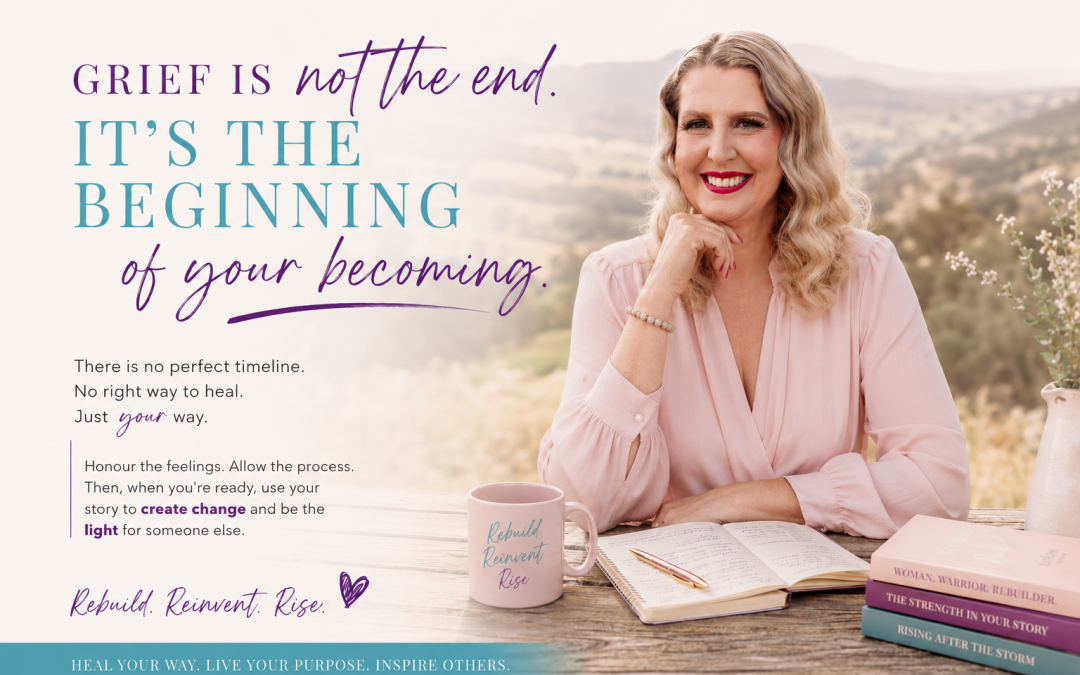
One of the greatest lies we tell ourselves about grief is that there should be a finish line. Six weeks. Six months. A year. Then surely we should be “back to normal.” But here’s the truth nobody talks about – there is no normal after profound loss. Our previous life as we knew it has gone for good.
Whether you’ve lost a relationship, a loved one, your career, your home, your health, your identity or simply the future you thought you were going to have, grief changes you. Trauma rewires parts of your brain designed to keep you safe. Your nervous system begins scanning for danger. Your body stores memories long after your conscious mind wants to move forward. This isn’t weakness. It’s biology. And every single person’s timeline is different.
Some people seem to bounce back quickly. Others find themselves overwhelmed months later, long after everyone else has stopped asking how they’re coping. Neither is wrong and comparison has absolutely no place in healing.
Imagine telling two broken bones they should heal at exactly the same speed despite being broken in different places and with very different fractures. It sounds ridiculous. Yet we do this to ourselves emotionally every day. “I should be over this.” “I should be stronger.” “I should have moved on by now.” According to who?
Grief isn’t a checklist to complete. It’s a relationship you slowly learn to carry and live alongside. There will be days when you feel hopeful. Days when anger arrives uninvited (and that has definitely been me of late). Days when sadness knocks the wind out of you over something completely unexpected and the tears come without warning.
The smell of a familiar perfume.
A song on the radio.
An empty chair.
The diary I didn’t save from the fire.
A date on the calendar.
Healing isn’t linear. It’s beautifully, frustratingly human. The most powerful thing you can do is allow yourself to feel every emotion without judging it. Not because you want to stay there. Because emotions that are acknowledged move. It’s absolutely okay to sit in them, just don’t allow them take you hostage.
Emotions that are buried often settle into the body, showing up as anxiety, exhaustion, irritability, chronic stress, poor sleep, or illness. Feeling isn’t the opposite of healing. Feeling is healing. But there is another important truth.
While we should never rush our grief, we also don’t have to build a permanent home inside it. Pain can become a teacher. Loss can become an invitation. Trauma can become the catalyst that reveals strengths you never knew existed. That I am continually learning day by day. Not because what happened was good. It wasn’t. Not because you’re grateful it happened (though it’s okay to be grateful for certain aspects – that doesn’t make you weird). You don’t have to be.
But because human beings have an extraordinary capacity to create meaning from the hardest chapters of life. Some people become advocates. Some become mentors. Some start businesses. Some write books (all of the above for me but hey I’m an over achiever). Some simply become the person they desperately needed during their own darkest season. That’s purpose.
Purpose isn’t pretending the pain never happened. Purpose is refusing to let the pain have the final word. One day you’ll notice something remarkable. You’ll be sitting across from someone whose eyes carry the same heaviness yours once did. And instead of offering clichés or telling them to “stay positive,” you’ll offer something infinitely more valuable. Understanding. Compassion. Hope. Evidence.
Because you’ll be living proof that while life may never return to what it was, it can still become something deeply meaningful. Your scars won’t disappear. But they’ll stop defining you.
Instead, they’ll become part of your story. Quiet reminders of your courage. Evidence that even after life’s fiercest storms, you chose not just to survive, but to rebuild. To reinvent. To rise.
If you’re in the middle of grief today, please remember this. There is no deadline. There is no perfect roadmap. There is no gold medal for healing the fastest. Take the next step. Feel what needs to be felt. All of it. Ask for support when you need it.
And trust that even if you can’t see it yet, every small step forward is shaping a future version of you who will one day become someone else’s light in the darkness. And that is one of the most beautiful legacies any of us can leave. I hope I’m doing exactly that.
Image: Chat GPT