
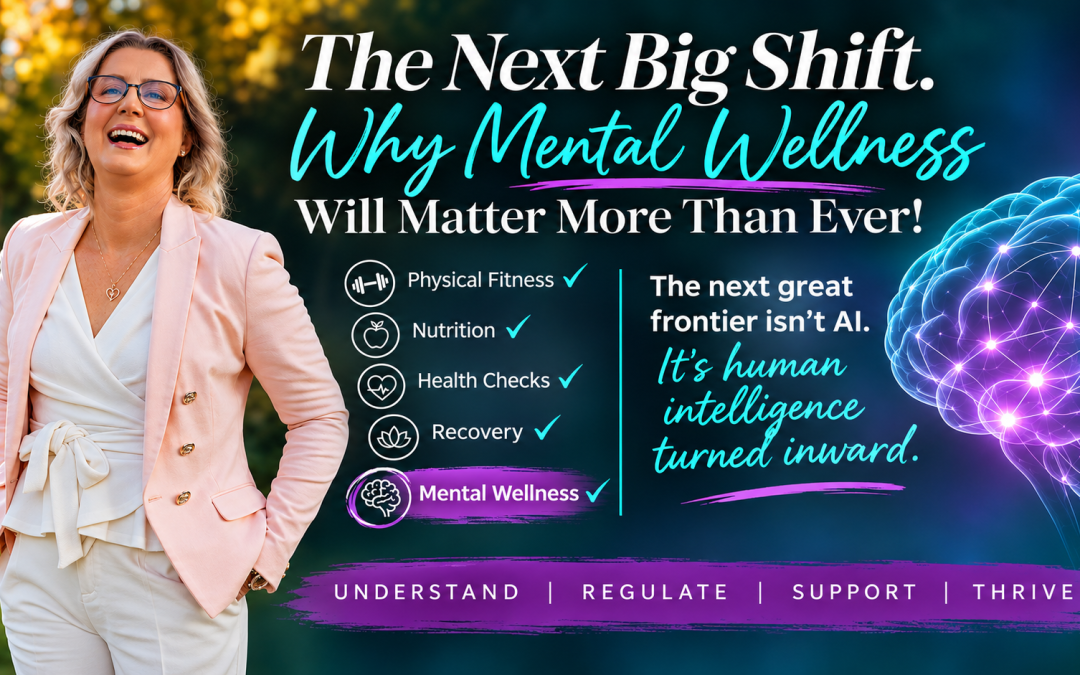
For decades, we have talked about physical fitness as something we actively manage. We exercise. We eat well. We get regular health checks (well we’re meant to, right?). We stretch, exercise, workout and recover.
But when it comes to our minds, we have traditionally waited until something goes wrong and that is beginning to change. I believe the next significant shift in our world will not be AI or electric vehicles or living on Mars. It will be mental wellness.
There is an important distinction between mental health and mental wellness.
Mental health is part of being human. It exists on a continuum, and it can be affected by life circumstances, trauma, stress, relationships, work and biology. Sometimes people experience significant mental health difficulties that require professional, psychological or medical intervention. And I have seen this with my Mother who has Bi Polar and my son who is Autistic. There should be absolutely no shame in speaking it out loud either.
Mental wellness, however, is about what we do proactively to support our psychological wellbeing. It is the daily practice of taking the time to understand ourselves, recognising our emotional patterns, actively regulating our nervous system, building resilience, managing stress, creating healthy boundaries, maintaining meaningful relationships and learning how to respond rather than simply react. Proactively. It is mental fitness.
And just as we would not wait until our body completely breaks down before deciding exercise might be a good idea, perhaps we should stop waiting for our minds to reach crisis point before we pay attention to them.
The significance of this shift is already being recognised in Australia. In Victoria, the Occupational Health and Safety (Psychological Health) Regulations 2025 came into effect on 1 December 2025. Employers now have specific obligations around identifying psychosocial hazards in the workplace, assessing risks, implementing controls and reviewing those controls. Psychological health is being treated as a legitimate workplace safety issue, alongside physical health. And that is a profound change for the better.
But legislation alone will not remove the stigma surrounding mental health. We can have policies, procedures and workplace programs, but if people still feel as though they exist in an environment where they feel too stigmatized to say, “I’m struggling,” then we have a very long way to go. And nowhere is the cost of that silence more devastating than in the conversation around domestic and family violence.
Australia continues to face an enormous family and domestic violence problem. AIHW data shows that more than one in four Australian women experienced family and domestic violence since the age of 15. Horrifying, right? Alcohol can be a contributing factor in violence, but it is important not to confuse a contributing factor with the root cause. Violence is a choice, and responsibility for abusive behaviour belongs always with the perpetrator. At the same time, emotional dysregulation, trauma, poor coping strategies and untreated psychological difficulties can be part of the complex landscape surrounding harmful behaviour.
Which is precisely why mental wellness matters. We need to become far more comfortable talking about what happens inside our heads before it turns into a crisis. We need to normalise emotional literacy. We need to teach people how to recognize stress before it becomes burnout, anger before it becomes aggression, disconnection before it becomes isolation and unhealthy coping before it becomes destructive and potentially dangerous behaviour.
And we need to make asking for professional help as ordinary as seeing a doctor when our body isn’t functioning properly. Mental wellness is not about pretending everything is fabulous. It is not toxic positivity. It is not telling someone to meditate their way out of trauma, grief, loss or suffering. And it certainly does not replace professional mental health care.
It is about creating a culture and indeed a society where looking after our minds becomes as normal as looking after our bodies. And sadly, we are nowhere near there just yet.
Because perhaps the next great frontier isn’t artificial intelligence. Perhaps it is human intelligence turned inward. Understanding ourselves and our behaviours. Regulating ourselves. Supporting one another. And finally recognising that the strongest future we can build begins with mentally fit people.
Image: Chat GPT