
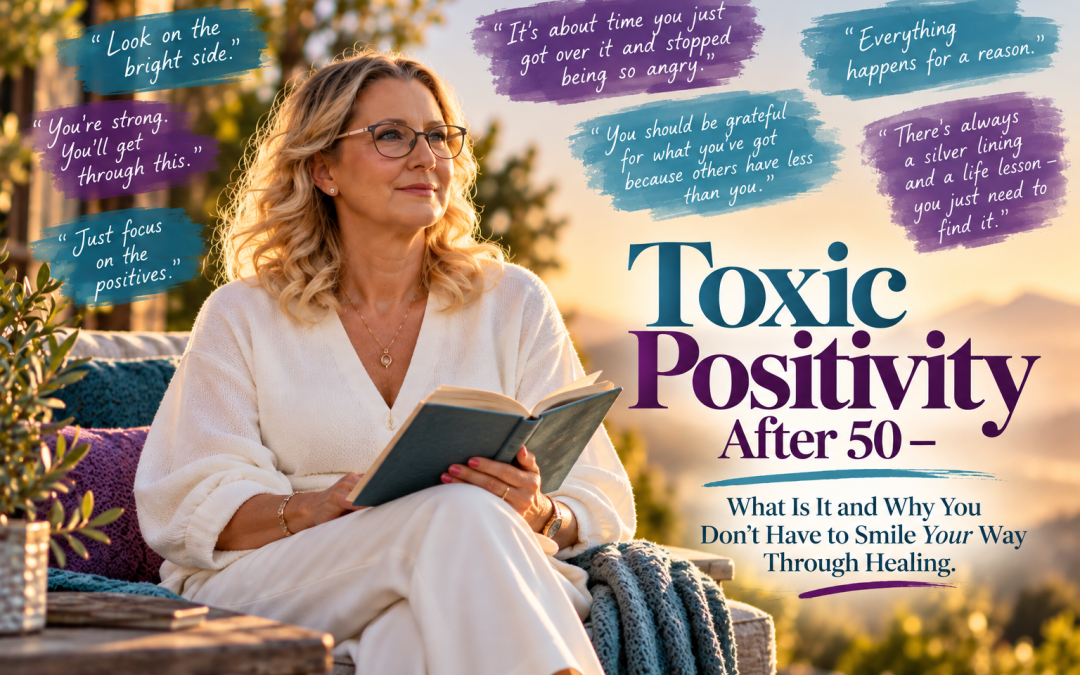
“Look on the bright side.”
“It’s about time you just got over it and stopped being so angry.”
“Everything happens for a reason.”
“You’re strong. You’ll get through this.”
“Just focus on the positives.”
“You should be grateful for what you’ve got because others have less than you.”
“There’s always a silver lining and a life lesson – you just need to find it.”
If you’re a woman over 50, chances are you’ve heard some version of these words more times than you can count. And yes, these are some of the things I’ve heard personally since January. Perhaps you’ve even said some of these to yourself.
Because women of our generation have been taught to get on with it. Because let’s be honest, we were largely left to our own devices as teenagers and told such things as crying isn’t ‘ladylike’ and ‘nobody likes a smart ass’.
But we have been ‘getting on with it’ for most of our lives. Raise the kids. Build the career. Support everyone else. Keep the family together. Be grateful. Don’t make a fuss. Put on a brave face. We became exceptionally good at carrying stuff. Oftentimes, mostly other people’s stuff.
But there comes a point when “being positive” can stop being empowering and start becoming another way of being silenced.
What is toxic positivity?
Toxic positivity is the pressure to maintain a positive attitude regardless of what you’re actually feeling or the practice of avoiding, suppressing or rejecting painful or difficult emotions by forcing an overly optimistic mindset in every situation (cited from “Psychology Today”).
It sounds harmless enough. After all, optimism is a good thing, right? Absolutely. But there is a huge difference between choosing hope and denying pain.
When you’re grieving a relationship, recovering from trauma, navigating divorce, dealing with betrayal, losing someone you love, facing an empty nest, changing careers or simply questioning who the hell you are now, being told to “just stay positive” can feel incredibly isolating and dismissive.
Because underneath those words can hold subtle messaging –
Your difficult emotions are inconvenient for me.
You are not negative because you’re hurting – you are just choosing to be so.
This is especially important for women over 50. We have spent decades becoming experts at putting everyone else first. Then, when life finally forces us to stop, we may discover a whole collection of emotions we’ve been too busy to confront.
Anger. Grief. Resentment. Fear. Sadness. Even sometimes relief.
None of these emotions mean you’ve failed at healing – they mean you’re human. And sometimes the responses from others can feel anything but. But after years of being the strong one, perhaps your next chapter isn’t about becoming even stronger. Perhaps it’s about becoming more honest and authentic.
Trauma recovery isn’t a gratitude competition
One of the problems with toxic positivity is that it can encourage us to leap straight to looking for the life lessons.
“What did this teach me?”
“How has this made me stronger?”
“What am I grateful for?”
Those questions can eventually be useful. But sometimes they come too soon. You don’t have to be grateful for what happened to you and you don’t have to call your trauma some weird kind of gift. You don’t have to find a silver lining before you’re allowed to acknowledge that something was actually fucked up.
I truly believe that it’s okay to be grateful for an event that has given us the opportunity to bring the deep desire for change. It’s okay to be grateful to be given the strength and determination to manifest something different in our lives – you don’t necessarily need to be grateful for ‘that’ event.
Healing isn’t about putting a pretty frame around an ugly experience. And choosing to march forward directly into rebuilding before you have properly processed the relief stage like some crazed, deranged drill sergeant isn’t helpful either. It’s about being able to look at what happened without allowing it to define the rest of your life.
After 50, you get to rewrite the rules
Perhaps this is one of the great opportunities of this stage of life. You get to stop performing “fine.” You get to say, “Actually, I’m not okay today.” And have I said that a lot lately! And no, I don’t have clinical depression and I’m guessing you don’t either.
At our age, we get to have boundaries. We get to feel angry. We get to grieve the life we thought we’d have by now. We get to question old beliefs. We get to clean house – whatever that means to you. And we get to decide that the woman we’ve been doesn’t have to be the woman we are now nor become. And that isn’t negativity – that’s real growth.
Real positivity leaves room for truth
Real optimism doesn’t say, “Everything is wonderful.” It says – “This is hard, and I believe I can and will find my way through it.” It says – “What happened to me matters, but it doesn’t get to write the rest of my story nor define me.” And sometimes it simply says – “Today, getting through the day is enough.”
Because healing isn’t about becoming relentlessly positive. It’s about becoming whole and real.
At 50, 60, 70 and beyond, you don’t need to smile your way through the hard stuff to prove you’re resilient. You’re allowed to cry, rage, rest, laugh and start over. And you can build a life that feels authentically yours, not one designed around keeping everybody else comfortable.
You don’t need to find the bright side before you’re allowed to find your way forward. And if this feels a little too familiar, maybe you’re at a point where you’ve spent enough years being the strong one. Maybe you’re ready to stop pretending you’re fine when you’re not. And that is absolutely okay. And maybe you’re wondering who you are now, what you actually want, and whether there’s more life waiting for you beyond everything you’ve been through.
There is no gold star for doing this alone. Give yourself permission to take the next step gently. Talk to someone you trust. Seek professional support if you’re carrying trauma that feels too heavy to navigate alone (I have and am still seeing a Psych). And surround yourself with women who understand that healing isn’t about becoming a shinier version of your old self. It’s about discovering who you are when you no longer have to abandon yourself to keep everyone else happy.
If you’re in that season of life right now, welcome. No forced positivity. No pretending. No “just get over it.” Just honest conversations, compassionate support and the possibility of creating a next chapter that feels more like you.
You haven’t missed your moment. You haven’t become too old. And you don’t have to have it all figured out before you begin. Maybe this is simply your invitation to begin again, gently, honestly and entirely on your own terms. Finally!
Image: Chat GPT