
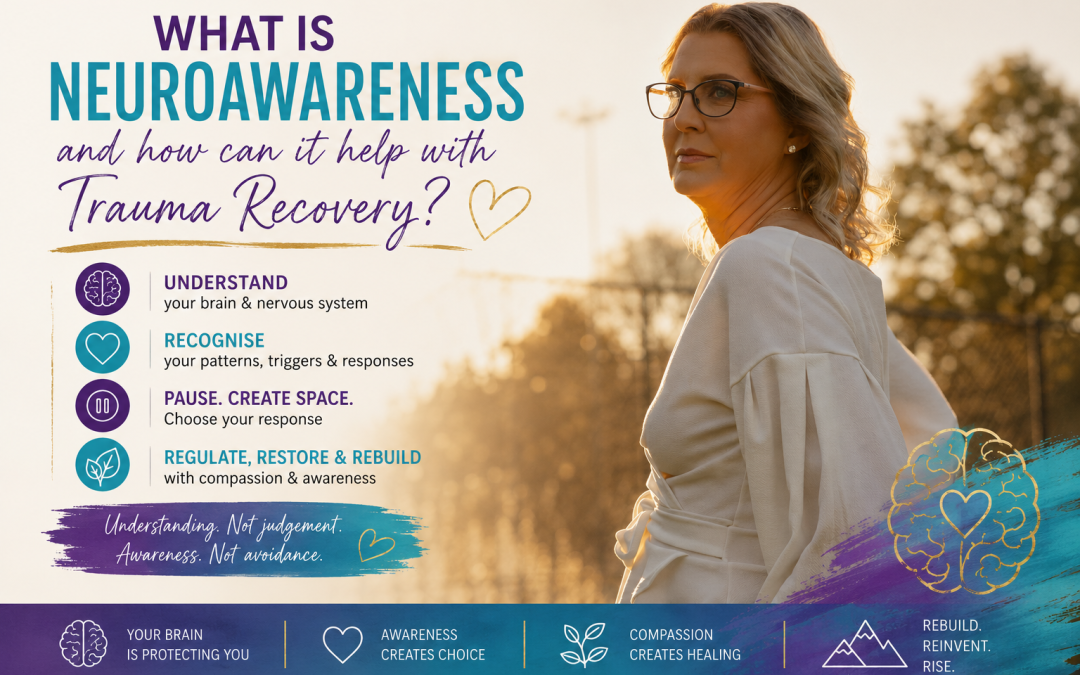
When living through a traumatic event, loss or major life upheaval, you can sometimes feel like your brain and body have suddenly become strangers. And you body can come up with a few little surprises along the way (which I’m continuing to find out …)
You might feel exhausted and yet wired. You may feel constantly on edge, overwhelmed by things that never used to bother you, disconnected from yourself or unable to focus. You might even wonder, “What the hell is wrong with me?”
The answer may have far less to do with what is wrong with you and much more to do with what your brain and nervous system has been through.
This is where neuroawareness can become a powerful part of trauma recovery and growth.
So, what exactly is neuroawareness?
Neuroawareness is an approach that connects brain science (neuroscience) with daily practices like personal leadership, conflict resolution and personal coaching. Neuroawareness is the practice of understanding how your brain, nervous system, emotions and behaviour interact, particularly in response to stress and perceived threats.
It supports you to recognise that many of your reactions are not random. Your brain is constantly scanning your environment for safety or danger. When you’ve experienced trauma, that threat-detection system can become overly sensitive. Your nervous system may remain in a state of heightened alert even when the immediate danger has passed.
That can show up as anxiety, irritability, hypervigilance, emotional shutdown, brain fog, sleep disruption, difficulty concentrating or feeling disconnected from yourself and others. Things that previously never ‘triggered’ you, now do in ways you never expected.
Neuroawareness gives you a framework for understanding these responses rather than judging them. And that distinction matters.
From “What’s wrong with me?” to “What happened to me?”
Trauma recovery isn’t about forcing yourself to “move on” or pretending everything is fine. It begins with understanding. When you develop greater awareness of your nervous system and what it is actually doing, you can start recognising your individual patterns and triggers. Perhaps a particular conversation makes your heart race. Maybe uncertainty sends you into overthinking and potentially even catastrophizing. Perhaps conflict makes you want to hide. Or maybe you notice that you become exhausted after being around people, even when nothing particularly difficult has happened. Seemingly simple interactions just plain wear you out – I feel you!
Neuroawareness encourages you to notice these responses without immediately becoming consumed by them. That creates something incredibly valuable: choice. Awareness can create space between the trigger and the response
One of the most powerful aspects of neuroawareness is learning to recognise what is happening in your body before your reaction takes over. You might notice your breathing becoming shallow, your shoulders tightening or in my case – rise, your thoughts speed up or your stomach clenches. You can feel it in any part of the body – the most important thing is to recognize what is happening.
Instead of automatically reacting, you can pause and ask:
“What is my nervous system telling me right now?”
That pause doesn’t magically erase trauma. But it can be insightful in supporting you to respond rather than simply react on autopilot
Over time, this awareness can support healthier regulation strategies such as grounding, breathing, movement, rest, connection and creating environments that increase your sense of safety.
Neuroawareness isn’t about fixing yourself
Perhaps the most important message is this:
You are not broken.
Your brain and nervous system have been doing their best to protect you. Trauma recovery is not about becoming the person you were before everything happened. Sometimes that person no longer exists. And sometimes that is a very good thing because sometimes it can actually reveal the best version of ourselves. Sometimes it takes a traumatic event to do that.
The most important thing though is to understand yourself more deeply, lean in to what your nervous system needs, and gradually build your capacity to feel safe, connected and present again. And that is a journey that doesn’t necessarily have a clear destination. It’s something we learn to walk alongside and not eliminate. It becomes part of us and part of our story.
Neuroawareness doesn’t replace professional trauma-informed support, therapy or medical care when those are needed. And I have been very open of the fact that I am still continuing to see a Psychologist regularly. But it can give you something incredibly powerful alongside of those things: understanding. Because when you understand what your brain and body are doing, you can stop fighting yourself and start working with yourself. And that is where rebuilding and then rising really begins.